The phrase Borobudur inner chambers can create an interesting question for visitors: does Borobudur contain conventional rooms or chambers inside its structure? Unlike many temples with enclosed sanctuaries, Borobudur is primarily an open monument designed around terraces, galleries, pathways, stupas, and symbolic spaces.
Does Borobudur Have Inner Chambers?
Borobudur does not have conventional interior rooms like many other religious buildings. Its design is largely solid, with stone blocks forming the terraces and central structure.
Instead of entering an enclosed sanctuary, visitors experience the monument by moving around its galleries and climbing through its different levels. This open arrangement is an important part of Borobudur’s architectural character.
The absence of traditional rooms does not make the monument less complex. Its internal construction supports an elaborate exterior system of reliefs, Buddha statues, stupas, and pathways.
The Monument’s Internal Construction
Understanding the idea of Borobudur inner chambers requires looking at how the monument was constructed. Large quantities of volcanic stone were carefully arranged to create its massive stepped form.
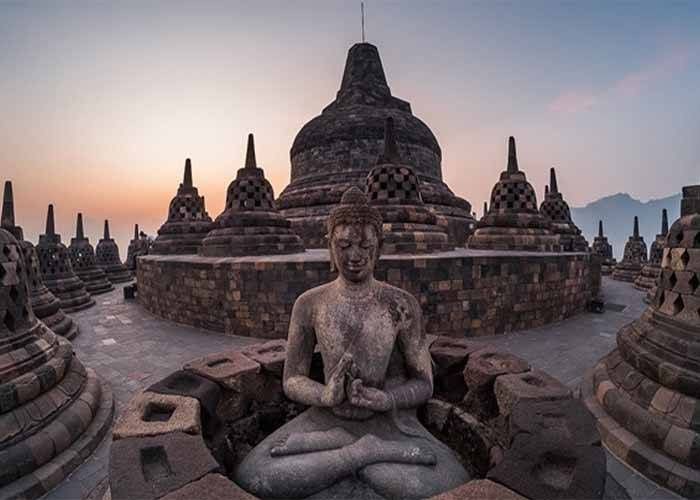
The square terraces contain galleries where visitors can walk around the monument. Above them are circular platforms with perforated stupas surrounding a large central stupa.
This layered arrangement gives Borobudur its distinctive appearance while also creating a structured path toward the summit.
Galleries Instead of Traditional Rooms
The galleries are among the most important spaces within Borobudur’s design. Their stone walls contain extensive relief panels that tell stories and communicate Buddhist teachings.
Visitors can move through these galleries without entering enclosed chambers. The experience is therefore based on movement through open architectural spaces.
As travelers climb higher, the environment changes from detailed square galleries to the more spacious circular platforms above.
For a more detailed explanation of these architectural elements, this Borobudur inside guide explores the monument’s structure, reliefs, and spiritual meaning.
The Central Stupa
At the top of Borobudur stands the large central stupa. It forms the visual center of the monument and is surrounded by circular platforms containing smaller perforated stupas.
The central stupa various from the surrounding stupas because it does not provide visitors with an accessible interior room. Its solid appearance reinforces the distinctive character of the monument’s uppermost section.
This arrangement also creates a strong visual contrast between the detailed lower galleries and the simpler forms near the summit.
Why Borobudur Is Designed This Way
Borobudur’s open architectural arrangement is closely connected with its symbolic purpose. The monument is commonly understood as a representation of a Buddhist spiritual journey.
Visitors physically move upward through various architectural levels, progressing from areas filled with narrative reliefs toward the more open upper platforms.
Rather than entering a series of rooms, the visitor becomes part of the monument’s spatial experience through walking and ascending.
Exploring Borobudur Beyond the Idea of Interior Space
The concept of Borobudur inner chambers is useful for understanding what makes this monument various from a conventional temple building. Its most important spaces are not hidden rooms but terraces, galleries, stairways, stupas, and open platforms.
Travelers interested in visiting Borobudur and explore other cultural destinations in Central Java can explore opportunities through Borobudur Tours.
Understanding the monument’s unusual design can make a visit more rewarding. Instead of expecting enclosed chambers, visitors can focus on how architecture, movement, sculpture, and symbolism combine to create Borobudur’s remarkable experience.